MCP server connecting AI models to OSC and MIDI hardware
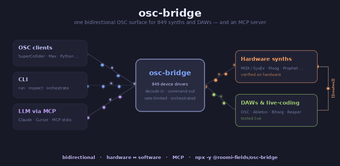
osc-bridge by Roomi Fields is a Model Context Protocol server that lets language models generate and edit music in real time. The bridge converts model outputs into audio-protocol actions so models can interact with instruments and software during sessions. It focuses on protocol bridging, control-surface mapping, and runtime parameter modulation. Intended for music producers, sound designers, and AI researchers who need programmatic access to hardware and DAWs within production workflows.
What tasks can you actually use it for?
The bridge turns a language model into a controllable production participant by exposing OSC and MIDI control surfaces over MCP. It can send parameter updates, trigger sequences, and route SysEx messages to external synths. Compatible software examples include
- Ableton Live
- Bitwig
- Reaper
- Sonic Pi
- SuperCollider
How reliable are real-time controls and state feedback?
The project implements bidirectional OSCMIDI/SysEx bridging so models can both send commands and receive device state, enabling closed-loop interactions. It exposes real-time parameter modulation and sequence control, and the application's core is written in Rust, a choice that provides high performance and low latency for live manipulation. Latency and timing accuracy depend on the host environment and connected hardware, so host selection affects responsiveness.
Is it practical to integrate into an existing production workflow?
The bridge integrates with any host that supports MCP, for example Claude Desktop, Cursor, or Zed, allowing models to join existing toolchains. Device discovery and named control-surface mapping reduce manual MIDI scripting, and a declarative configuration format makes hardware mappings reproducible across sessions. The workflow assumes familiarity with MIDI/OSC routing and MCP concepts to set up mappings effectively for repeatable sessions.
Suited to technically minded producers and researchers
The bridge suits producers, sound designers, and AI researchers who need programmatic instrument control and are comfortable with developer tooling; it requires an MCP host and either npx in a Node.js environment or a Rust local build, so non-technical users may face a setup hurdle. Expect an initial configuration learning curve for production use.